

NYU Shanghai community members are finding that putting away their phones helps them carve out more time for creativity, observation, and connection. From DIY postcard making activities to no-phone treks off campus to device-less classrooms, students and faculty members are opting to disconnect from their phones to connect in person.
Global China Studies major Theodore Tolan ’26 says hearing about the growing Reconnect Movement happening on college campuses around the US inspired him to design a no-phone event series with NYU Shanghai's Community Engaged Learning Office. The concept of Mostly Walking is simple but powerful: students surrender their devices for a group walk off campus, committing to being present in the moment with each other.
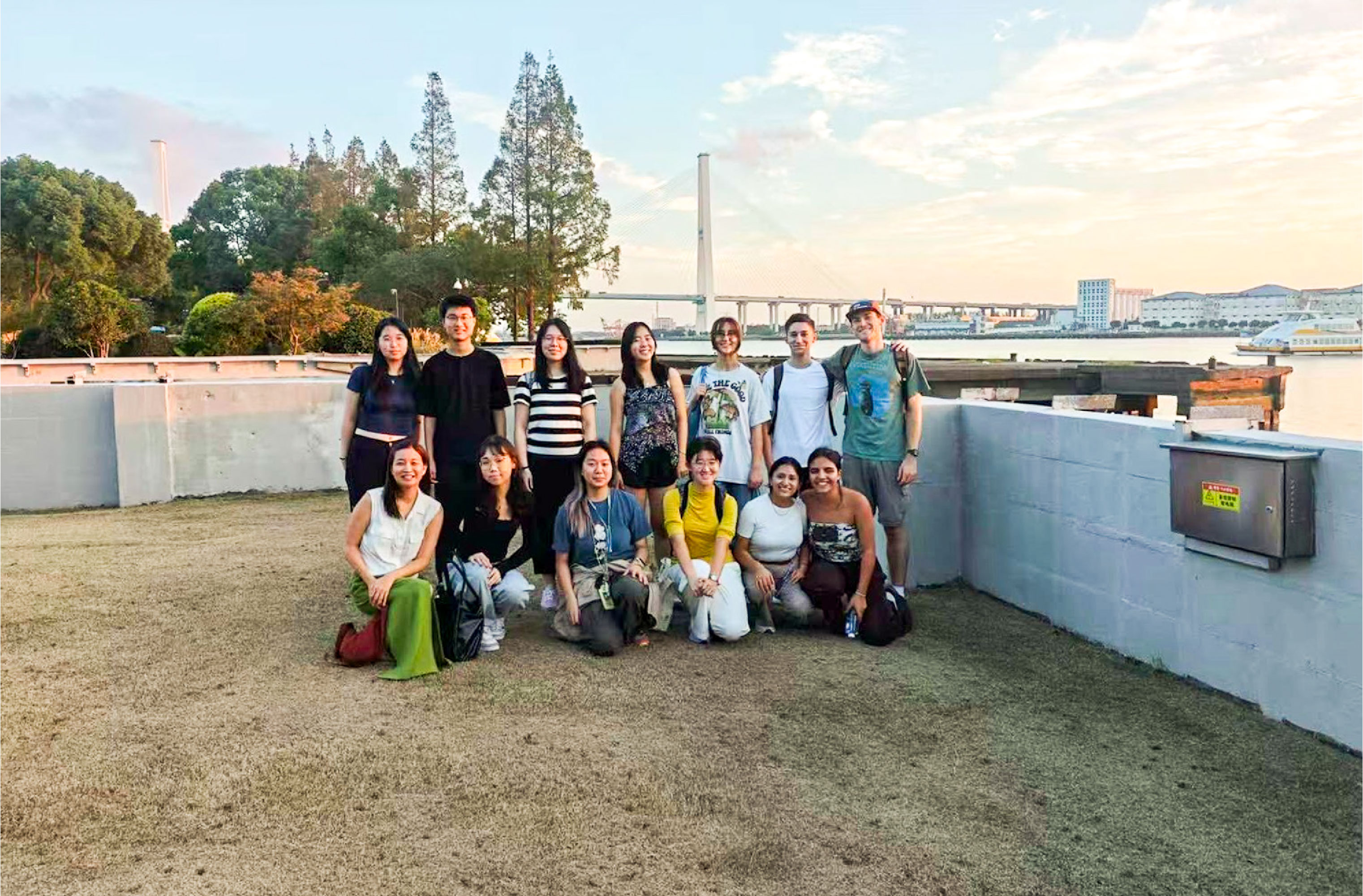
At the first few Mostly Walking events, some participants were frustrated at first with having to stow their phones away, as they were looking forward to taking photos, recalls Theodore. “If anyone else doesn't trust themselves to not use it, you can give it to me now,” he says he told them, and three or four more people gave their phones to him.
After adding his own phone to the designated “valet bag,” Theodore led the group to a park and riverside near campus, where they found a quiet spot to unwind and chat. “We shared with each other how we might bring the peace that we feel now into our life next week as well,” he says. “It was really lovely.”
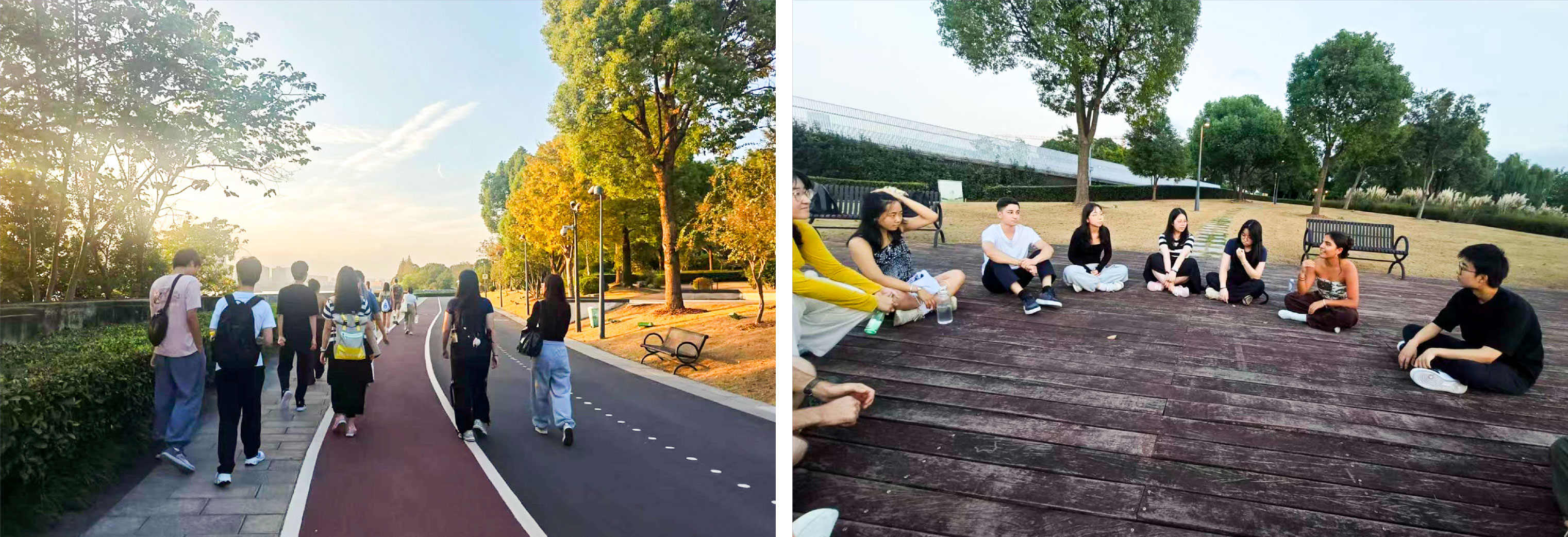
Theodore is not a ‘phone hater’ though. “Phones are okay, they just don’t belong in all spaces,” he says. “My childhood and social groups have been a little bit disrupted by technology–even if it was video games or social media in high school.” In his experience, the disconnect caused by devices has continued on into college, with university life solely emphasizing reflections on academics while lacking channels that allow for vulnerability.
“We want people to disconnect from phones, but we don’t want them to disconnect from each other,” he says. “I think making more time for what’s going on in our own lives is important—recognizing the importance of checking in with ourselves and our friends.” Theodore says it’s not about making ourselves or others feel guilty or stressed about phone usage—the key is to be kind to yourself, acknowledge feelings, experiment with solutions, and to not give up.
One of the best parts of phone-free walking? Noticing vivid details about your immediate surroundings while resisting the urge to document it all, says Theodore, who vividly recalls the mudskippers the group saw along the river, contrails left by planes across the horizon, and taking in a sunset with no screens in sight.
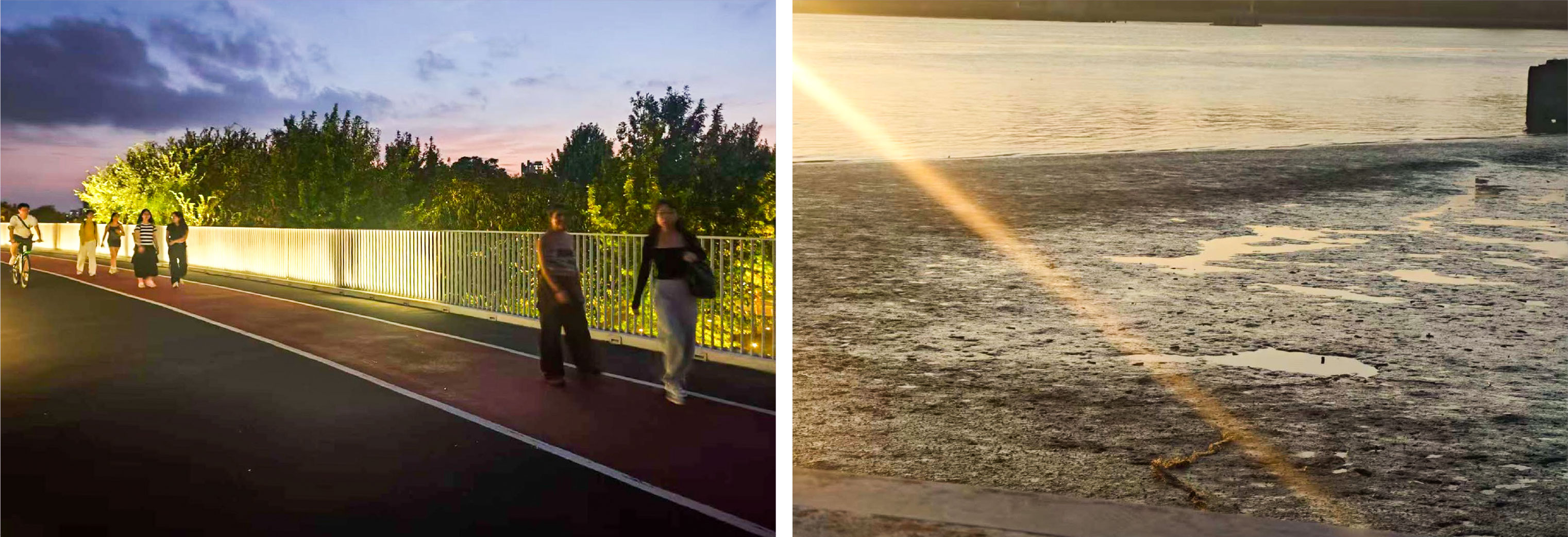
While many of us have the impulse to capture moments as photos, “once you create that physical barrier between yourself and the moment, it loses a little bit of specialness,” he says.
His friend and fellow walk facilitator Maria Rivera Calleja ’28 taught the group a new method for savoring the moment—taking a picture with one’s mind. “She was telling everyone, ‘You look at it for a while, and you just close your eyes really hard and it’s in your memory forever now,” he says. Theodore says he can still see the tree and the sky that was there at that moment in his mind.
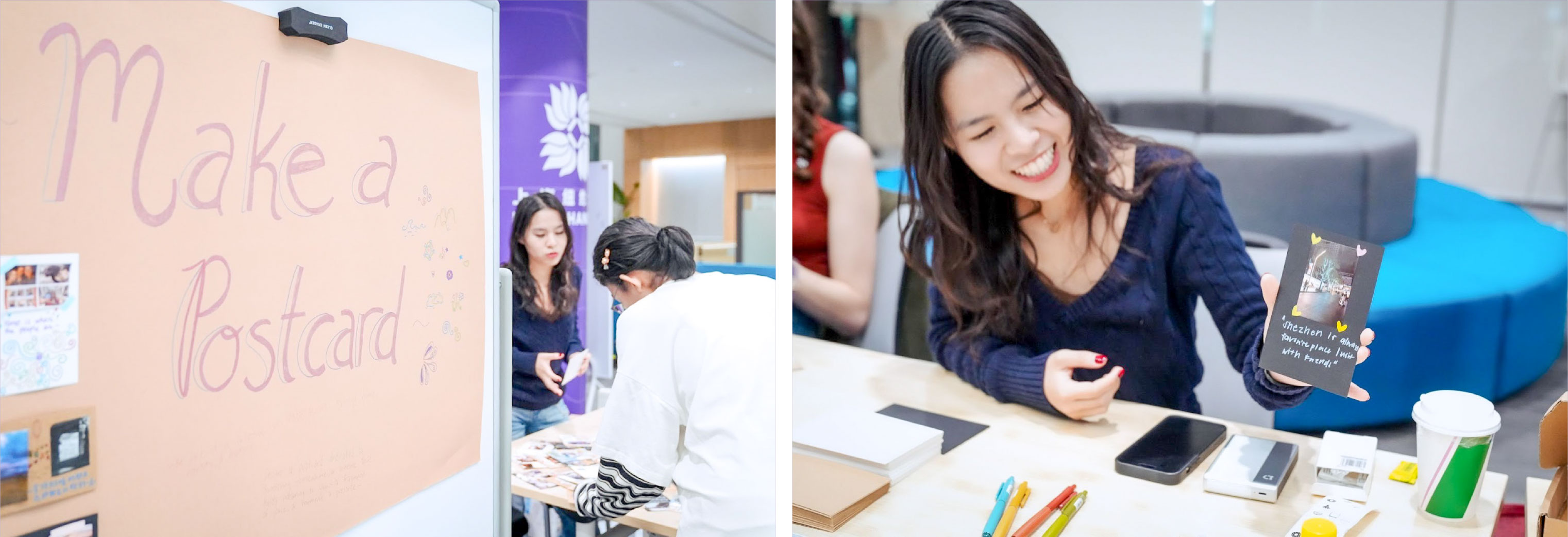
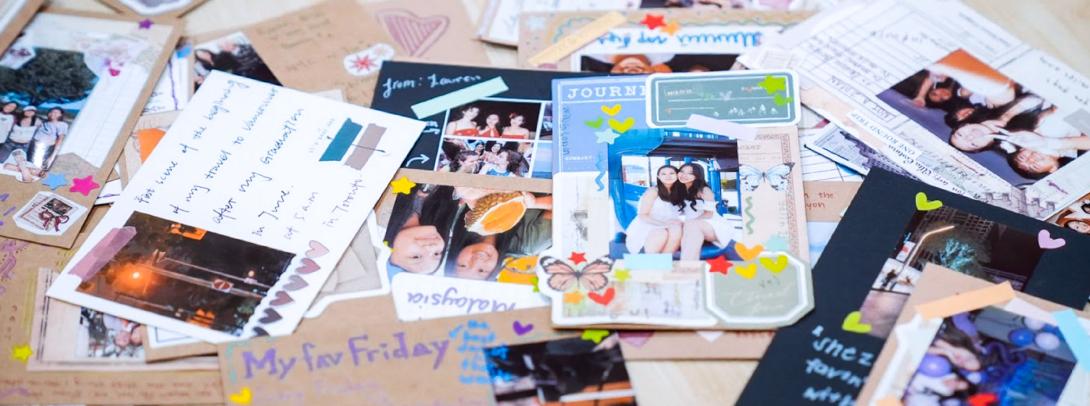
Another student looking to foster community around analog activities is Mia Liang NYU ’27, a study away student majoring in Interactive Media Arts. Supported by NYU Shanghai’s Creativity and Innovation Fellowship, she designed a DIY postcard-making activity stationed next to the Magnolia House cafe, hoping to spark conversation and creativity while hearing the stories of NYU Shanghai students.
On Mondays and Fridays—the two days she doesn’t have class—Mia “moved into” Magnolia House to host tabling from 11:00am to 7:00pm, and says that being there in person was crucial to her activity’s success. The spread of stickers, markers, and eye-catching scrapbooking materials attracted a crowd of curious students. Some stayed to collage, color, and craft their favorite memories into postcards.
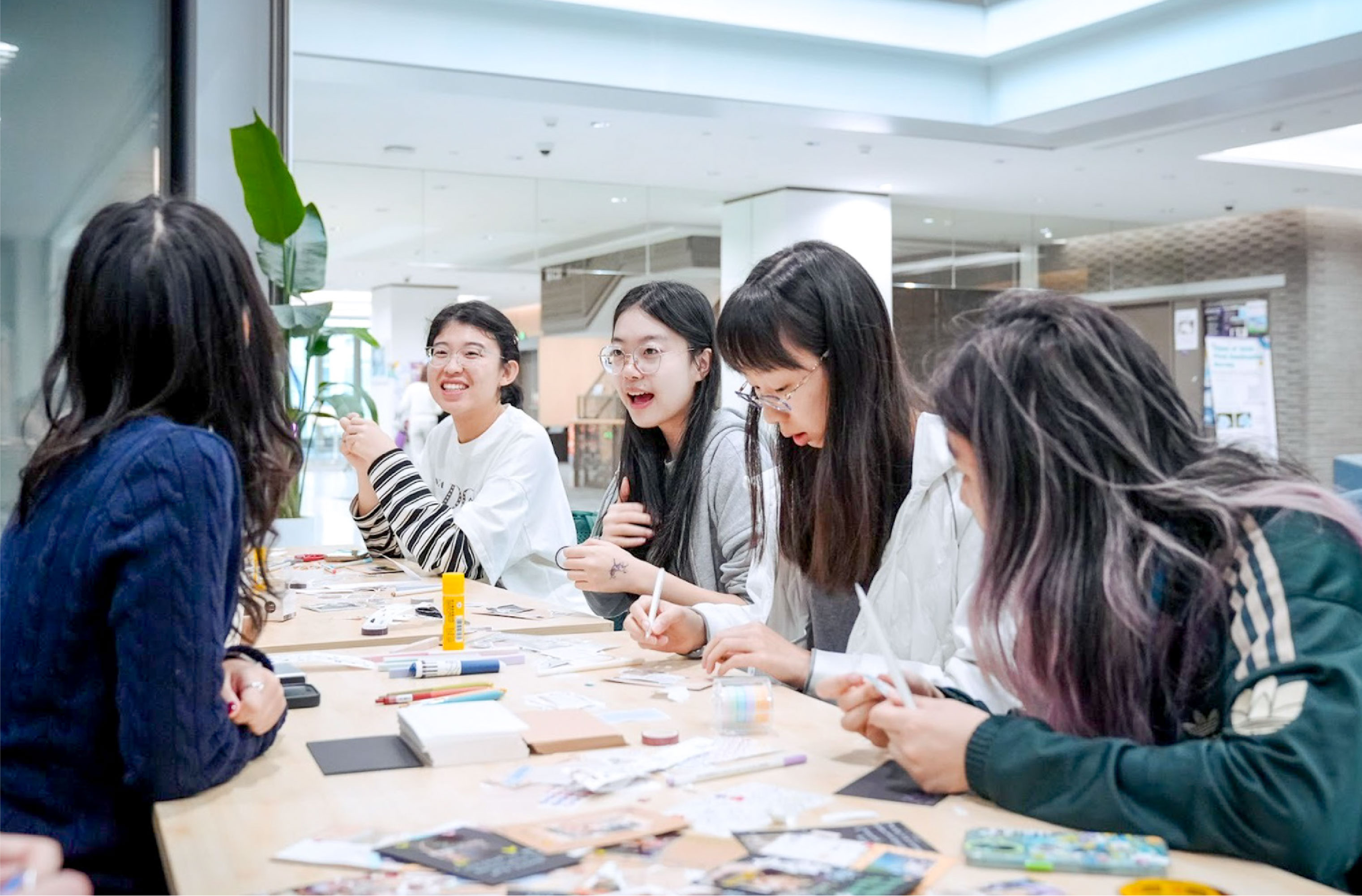
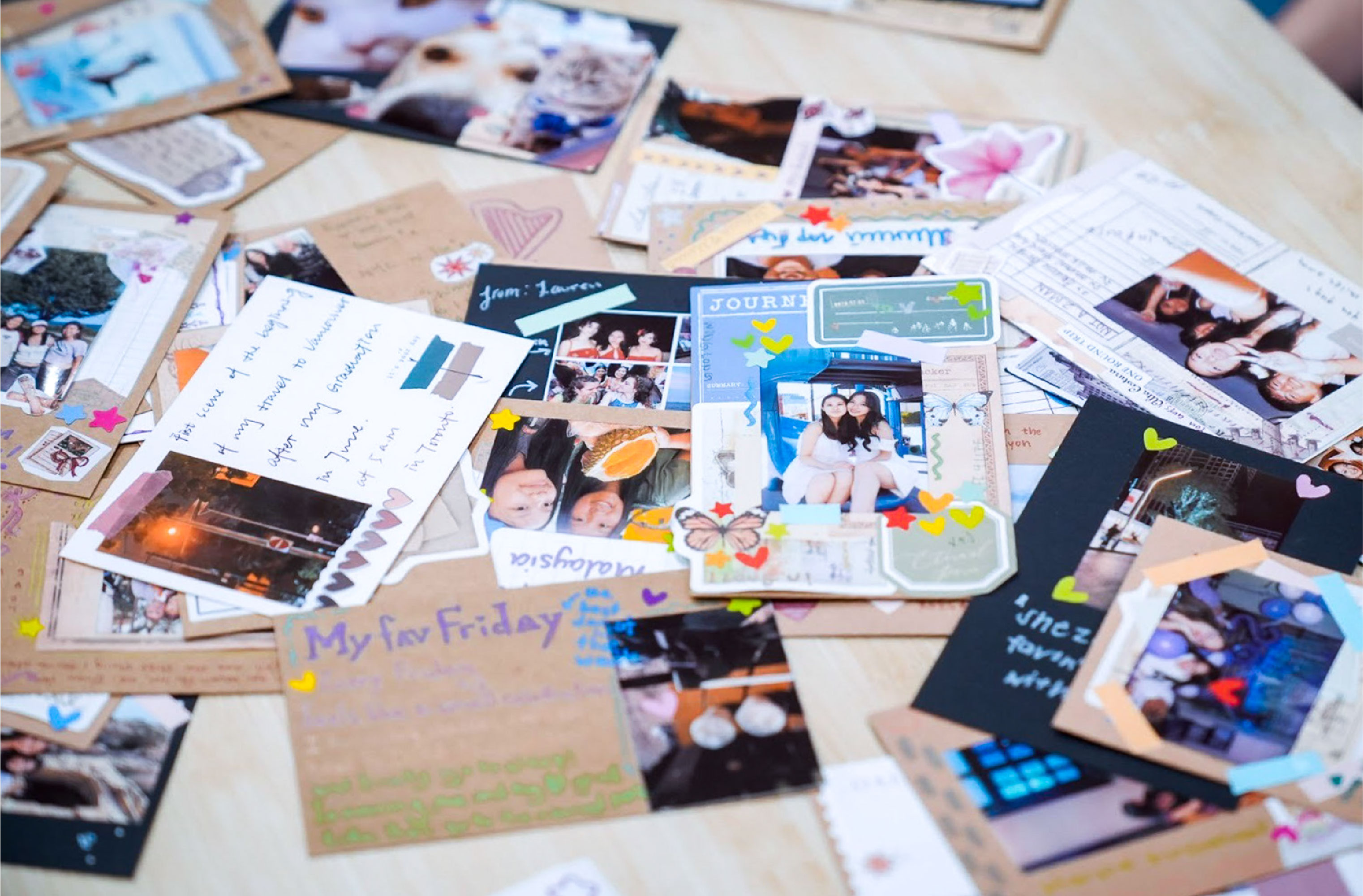
“I wanted people to make a postcard where they simply highlighted something important to them,” she says. “Some people made a postcard about their friends, while others made a postcard about a memory or a specific place, like a trip they really enjoyed.”
Mia says it was nice to observe students writing messages by hand while tuning into what makes us human—our emotions, stories, and connections. “Two friends who spent a while making a postcard at the table were just talking about how much they miss their friends and how they wanted to call them asap, which I felt was really wholesome,” she says. “Nowadays people are so caught up—busy with stress, tests, and work—that they don’t take the time to really appreciate the people that are important to them and the places that are important to them.”
Identity, home, and belonging are central themes in Mia’s life and artwork. Born and raised in New Jersey, USA, she and her family moved to Abu Dhabi when she was eight; she eventually returned to the US to attend college at NYU and is now using her study away semester in Shanghai to build community.
“As an artist and as someone who has lived in a lot of different places, connection, community, and identity are very important to me,” she says. “Having been exposed to so many different cultures living in different areas, the constant change makes me feel like I both belong everywhere yet also don’t belong anywhere at all——so it’s always been my goal to try to create a sense of community by having meaningful conversations and getting to know others.”
The postcard-making activity is part of her self-exploration journey during her study abroad semester in China. Mia continues to create personal artworks that combine both analog and digital media, centering on themes of identity and community. “I’m so grateful that through this event I was able to have conversations with other NYU Shanghai students who have also crossed cultural barriers, moved around the world, and traveled across continents,” she says.
Hearing their stories inspired her final project for the fellowship: a multimedia visual narrative redefining the Chinese idiom 人山人海 (people mountain, people sea). “This visual story not only highlights my own experiences navigating my identity,” she says, “but also emphasizes that despite being in a sea of people, everyone has a story worth telling.”
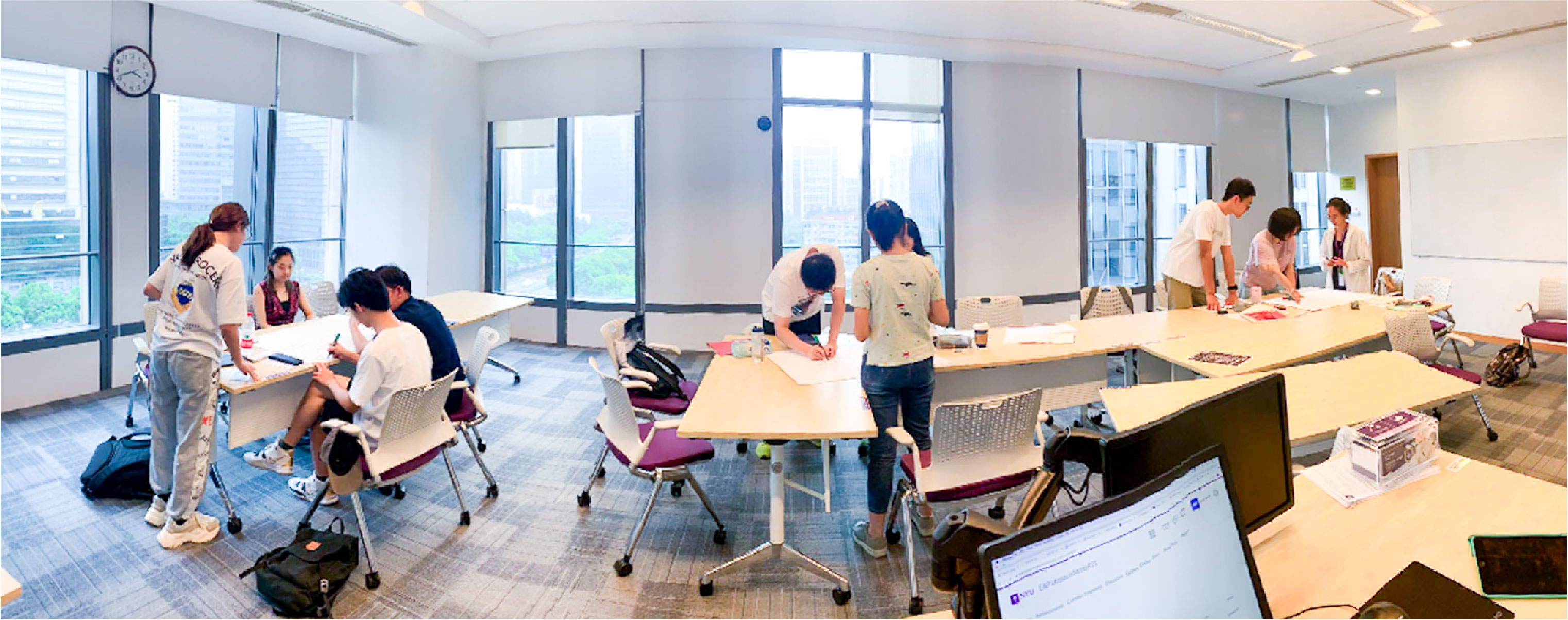
Meanwhile, faculty members are also trying to find ways to optimize device-free human connections. Senior Lecturer Sarah Warfield, who teaches English for Academic Purposes to first year Chinese students, doesn’t believe students are entirely at fault for being distracted by their devices. “As teachers, we need to think about how we're creating an engaging classroom for the students that come in,” she says.
Warfield, who has twenty years of teaching experience, has begun asking her students to leave their phones turned over on their desks at the start of class. “I invite you to close your laptops,” she tells her students, and often she takes out her own phone and says, “Let's turn over our phones.” Students aren’t explicitly forbidden or penalized for using their phones but are encouraged to respect the classroom atmosphere and move out into the hallway if there is an urgent need to check their device.
The atmosphere in Warfield’s classroom is less laptops and more paper, pen, and brainstorming on whiteboards. It may seem surprising that Warfield operates a “no-tech” classroom environment when her research interests include generative AI tools in language learning and teaching with technology. “We don't use any technology in the classroom, but we do use a lot of technology for out-of-class assignments,” she says. “It's definitely part of my pedagogy now…I will send them out to complete AI-integrated tasks, and they'll use other educational learning tools.”
Homework assignments may include watching videos online or using AI tools like ChatGPT and Perplexity, but Warfield prepares paper copies for any readings that students need to complete ahead of their group discussions. “I give them paper to sort of set the tone for the class,” she says. And while students can take notes on paper during class, their laptops remain closed.
“We unpack it face-to-face, which I think really aligned so nicely with where we are right now with AI and education,” Warfield says about the group work in her class. “It should be humanistic, it should be discussed, it should be ethical and practical, and you cannot have discussions about humanistic applications of AI unless you're actually discussing it as humans.”
The “very old school” classroom environment that she’s created centers on fostering interpersonal interactions as her students strengthen their debating, presenting, and overall English language skills. They are also expected to brainstorm and develop their own research topics in person.
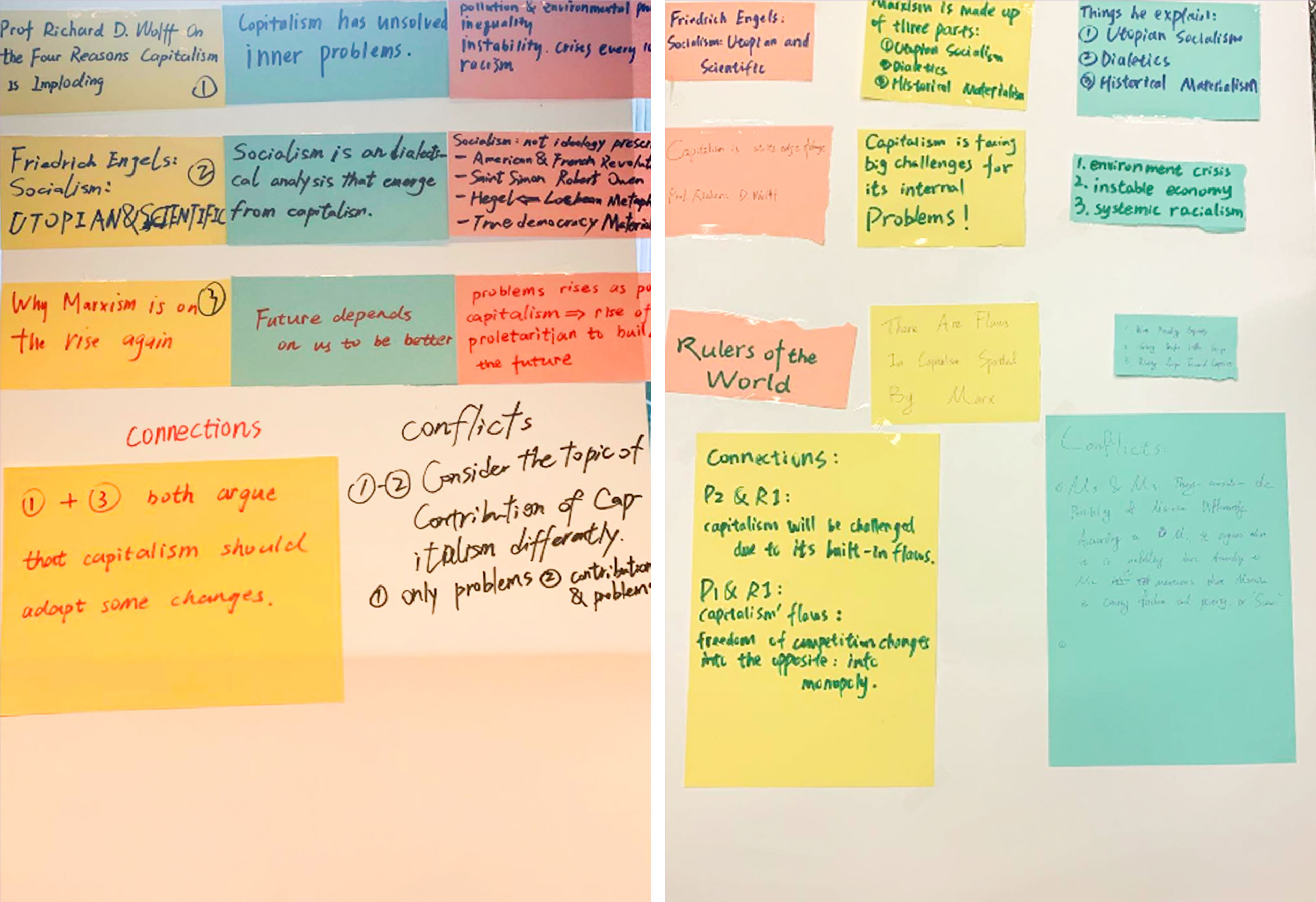
“It's really important that you generate your own ideas for the work that you do, for the paper you're going to write, the presentation you're going to give,” she says to her students, before guiding them through a step-by-step brainstorming worksheet, where ideas are generated in person in class and if needed, reassessed together during her office hours. Once their topic has been chosen, students use AI tools like Perplexity to find non-academic sources, but are asked to ensure each source’s credibility. “There’s your critical element to using AI; we always want them to question the output,” she says.
“We're there to guide students…to help refine their thinking, and also help them have confidence in their ideas and confidence in their ability and aptitude,” Warfield says. “For me, it's the only way forward to have interactive classes, to have engaged students, and to have students who are listening to one another, and really learning as much as they can.”