

On December 5, NYU Shanghai’s Volatility Institute (VINS) hosted its 10th annual conference, bringing together around 200 attendees to examine the theme “Financial Implications of Geopolitical Risks in a New Era.” The day-long event convened scholars, policymakers, and industry practitioners to discuss how geopolitical risk is measured, priced, and managed, and what new tools and evidence can help institutions respond more effectively. The conference featured two keynote addresses, five paper presentations, a luncheon speech, and a panel discussion.
In their opening remarks, NYU Shanghai Chancellor Tong Shijun, Vice Chancellor Jeffrey Lehman, and Provost Bei Wu noted that today’s world is shaped by rapid shocks and persistent uncertainty, making geopolitical risk an increasingly urgent topic for both research and practice. They emphasized VINS as a platform for applying rigorous analytical tools and interdisciplinary perspectives, grounded in NYU’s global network and Shanghai’s role as a major financial hub, to better understand volatility and strengthen financial resilience.

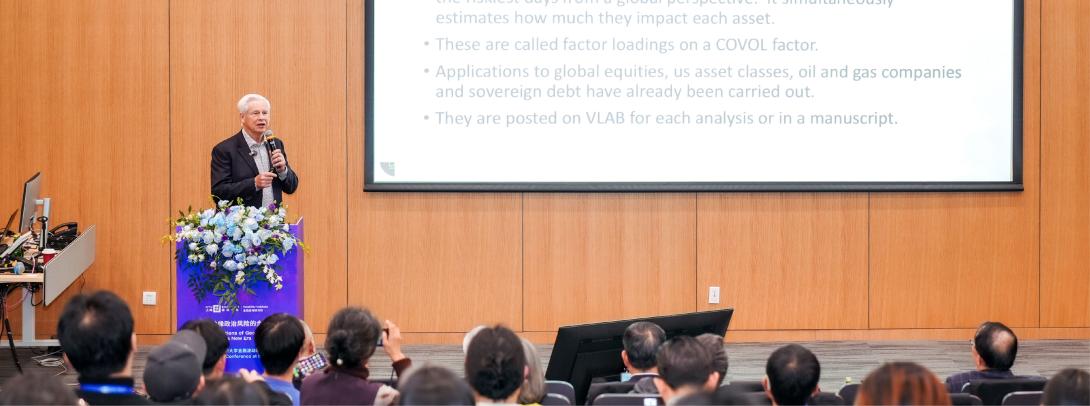
A key highlight of the conference was the keynote address by co-director of VINS and NYU Stern Professor Emeritus of Finance Robert Engle, the 2003 Nobel laureate in economics. In his talk on the financial implications of geopolitical risks, Engle argued that geopolitical risks are often global in scope, affecting multiple countries and asset classes in ways that can be difficult to diversify away, and that markets may price such risks in as investors adjust their exposure.
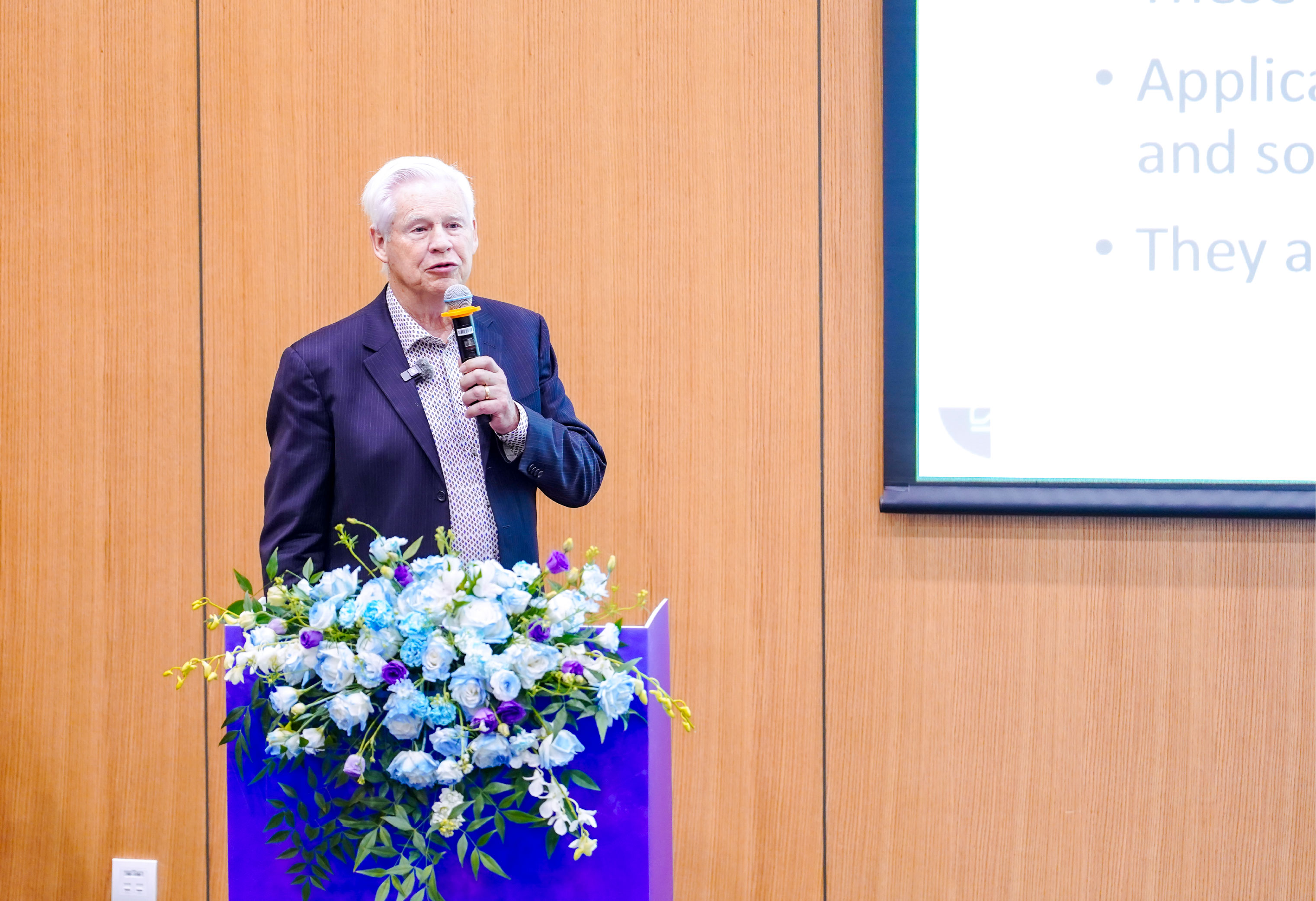
He introduced the COVOL (common volatility) framework, which seeks to identify the riskiest days from a global perspective and estimate how strongly different assets and markets are affected through their factor loadings. Turning to risk management, he discussed volatility targeting, also known as volatility control strategies, as a potential layer of protection during global shocks, and concluded with a forward-looking assessment of today’s shifting geopolitical landscape, offering cautious reflections on why markets remain resilient despite elevated tensions.
Hong Kong University of Science and Technology Finance Department Chair Professor Zhang Chu chaired the morning session which opened with a paper presentation on the pricing of geopolitical tensions over a century, by Ohio State University Associate Professor of Finance Andrei Goncalves. It was followed by a keynote address by Stanford Graduate School of Business Professor of Finance Matteo Maggiori, who spoke on geoeconomic pressure. The session concluded with Xing Ying of the University of Connecticut presenting on the hidden costs of trade protection, agency problems in firms shielded from competition.
During lunch, CICC Global Institute Dean, Chief Economist, and Head of Research Department Peng Wensheng delivered a luncheon speech on how scale, competition, and policy dynamics are shaping the evolving geo-economic environment.
The afternoon session, chaired by NYU Shanghai Assistant Professor of Finance Geoffery Zheng, continued with three paper presentations examining how geopolitical frictions transmit through financial markets. Zhao Xiaoyu of the University of Massachusetts Amherst presented on hedge fund performance and US-China tension, followed by Wen Xudong of the Hong Kong University of Science and Technology on the information constraint in market-based sanctions enforcement, and Li Qin of Shanghai University on how geopolitical risk and oil uncertainty reshape tail risk spillovers across green and brown markets.
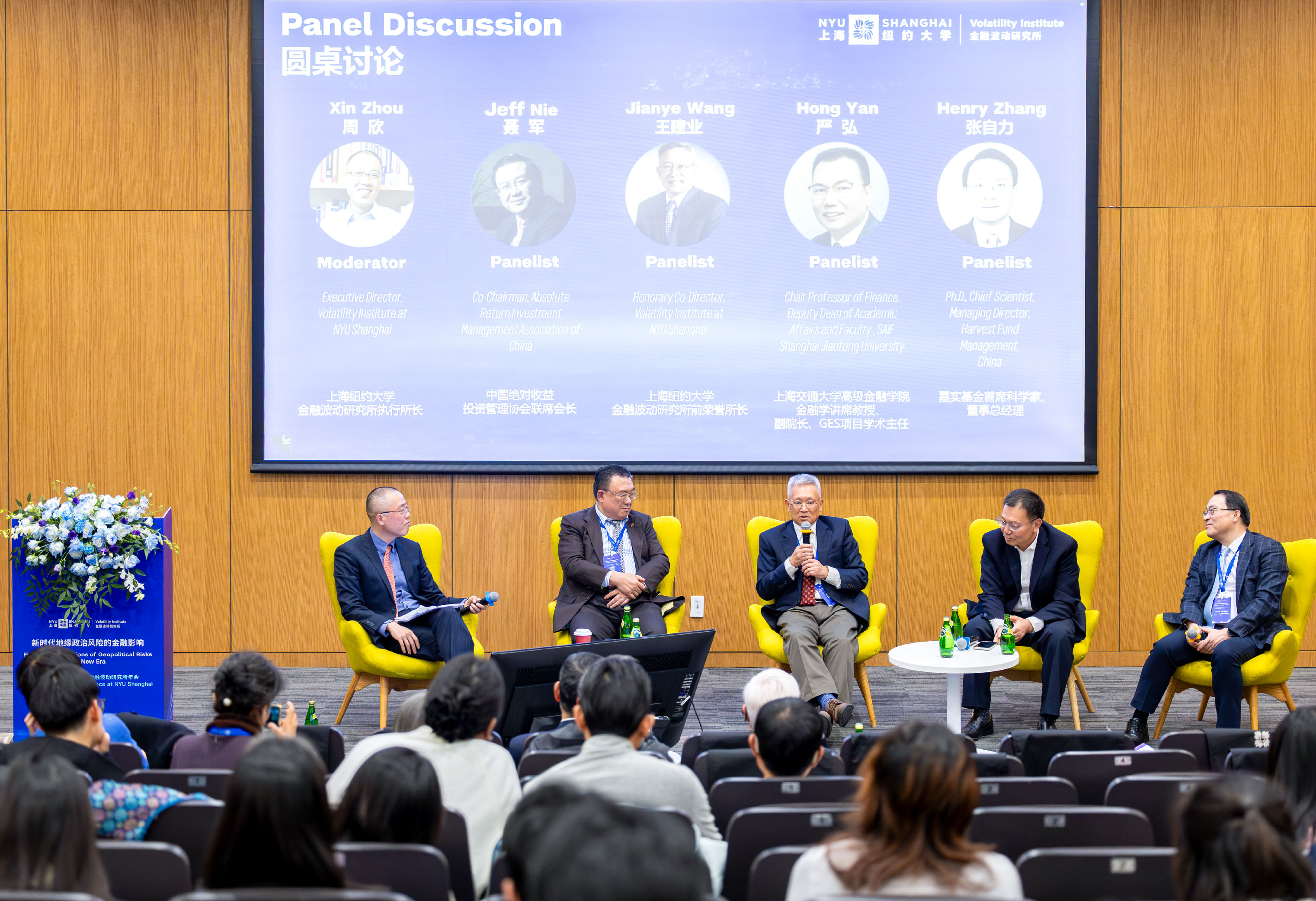
The session closed with a panel discussion on the financial implications of geopolitical risks, featuring Co-Chairman of Absolute Return Investment Management Association of China Jeff Nie, Honorary Co-director of VINS Wang Jianye, Chair Professor of Finance and Deputy Dean of Academic Affairs and Faculty of Shanghai Jiaotong University Yan Hong, and Chief Scientist and Managing Director of Harvest Fund Management Henry Zhang, moderated by Executive Director of VINS Zhou Xin.
Since its founding in 2015, VINS has worked to advance research on volatility and risk while connecting academic insights with real-world financial practice. The annual conference remains a cornerstone of that mission, creating space for rigorous exchange across disciplines and sectors on questions that are increasingly central to global markets and financial stability.